
When Careers Change Because Life Does
Estimated Reading Time: 5 minutes
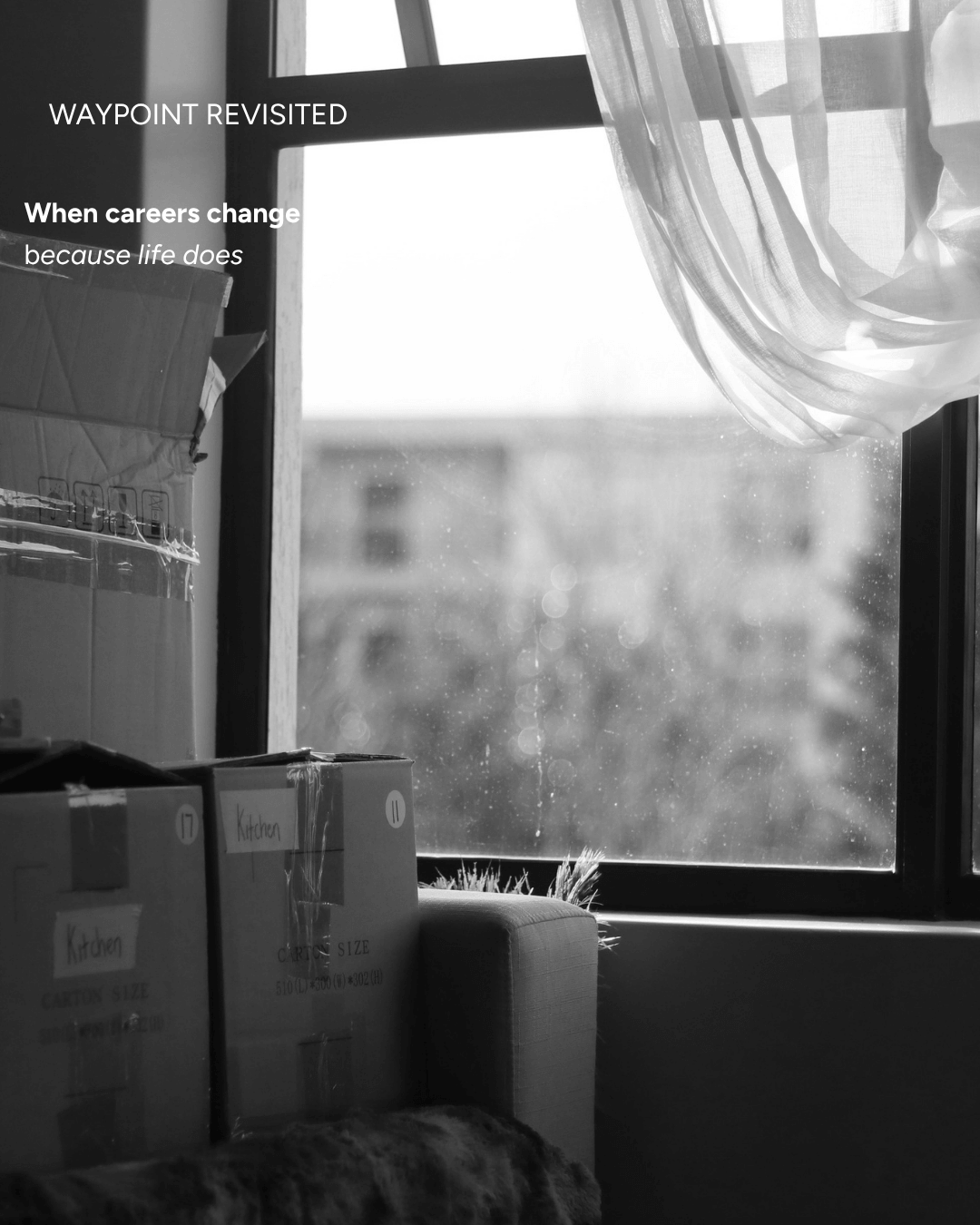
This Career Story looks at what happens when circumstances outside work reshape the choices we make within it. Image: Alicia Christin Gerald / Unsplash.
Many people assume career change begins with a decision.
A search for something better.
A promotion.
A new challenge.
Higher pay.
Sometimes it does.
But sometimes life changes first.
A former colleague got in touch after reading some of my Waypoint articles.
They wondered whether their own experience might help someone else facing uncertainty.
They had built a career of more than 20 years in education.
Experienced, respected and committed to their work.
They weren't looking for a career change.
Then something completely outside their career changed everything.
When home changes work
The home they were renting was sold.
Suddenly, they were navigating a housing market that had changed dramatically.
Like many people faced with circumstances they hadn't planned for, they had decisions to make that extended well beyond where they worked.
Eventually, moving interstate made sense.
Financially.
Personally.
For their life.
There was just one significant complication.
They didn't have a job to go to.
This wasn't the familiar version of career change where someone decides they've had enough and begins looking for something different.
Their career decision was being shaped by something happening elsewhere in their life.
And that distinction matters.
“Sometimes we don't decide to change careers. Life changes, and our career has to change with it.”
Starting without the perfect opportunity
Once the decision to relocate had been made, there was still the question of work.
They could have waited until the right advertised role appeared.
Instead, they started conversations.
They spoke with people they trusted.
They identified an organisation whose values and approach to education appealed to them.
And they contacted that organisation directly.
There wasn't an advertised position.
In fact, the organisation was restructuring and couldn't offer anything immediately.
So there was no instant success story.
But there was a conversation.
Their experience, professionalism and genuine enthusiasm for education helped establish a relationship.
They stayed in touch.
Then, when the right opportunity emerged, the organisation contacted them.
A conversation that began without a vacancy eventually became the beginning of the next chapter of their career.
Careers don't happen separately from life
Their story reminded me of something I saw repeatedly during my years working in employment services.
We often talk about careers as though they exist in their own neat compartment.
Qualifications.
Skills.
Experience.
Applications.
Interviews.
Jobs.
But people's lives aren't organised into compartments.
I've worked with people trying to establish themselves in new jobs while sleeping in their cars.
Others were couch surfing, arriving at work exhausted after another night wondering where they would sleep.
For them, the challenge wasn't simply finding employment.
Housing mattered.
Transport mattered.
Family mattered.
Money mattered.
Health mattered.
What was happening outside work inevitably affected what was possible inside it.
No part of our lives, including our careers, exists in isolation.
Context changes the question
That's one reason I believe a useful career conversation should rarely begin with a résumé.
A résumé tells us something important.
It can show where someone has worked, what they've done and some of what they've achieved.
But it can't tell us everything that's happening around the decision they are trying to make.
Someone considering a career change might also be:
caring for a parent,
raising children,
recovering from an injury,
moving to another city,
managing changing finances,
returning after time away from work,
supporting a partner's career,
or simply discovering that the life they want now is different from the life they wanted ten years ago.
Those circumstances aren't distractions from the career conversation.
They are part of the career conversation.
The question may not simply be:
“What job should I do?”
It might be:
“What kind of work fits the life I need to build now?”
That can lead to a very different conversation.
Working with what we can influence
There was a lot my former colleague couldn't control.
They couldn't control the decision to sell the home they were renting.
They couldn't control the housing market.
They couldn't manufacture a vacancy in the organisation they wanted to work with.
But they could decide what to do next.
They could talk to people.
Research organisations.
Make contact.
Explain what they could offer.
Stay connected.
And remain open to an opportunity that might take time to emerge.
That doesn't mean persistence always produces the outcome we want.
It doesn't.
Sometimes circumstances remain difficult despite our best efforts.
But when so much feels uncertain, identifying the things we can influence gives us somewhere to put our energy.
A career can change without something having gone wrong
Perhaps this is the part of the story I value most.
Career change is often presented as a response to a problem.
A bad boss.
Burnout.
Redundancy.
The wrong career.
A job we've outgrown.
But sometimes there is nothing wrong with the career we're leaving.
It simply no longer fits the circumstances of the life around it.
That isn't failure.
It is change.
And career development isn't only about choosing occupations or climbing ladders.
Sometimes it is about adapting.
Reconsidering.
Finding another way to use what we already know.
Building new relationships.
And making thoughtful decisions with the circumstances we actually have, rather than the circumstances we wish we had.
My former colleague didn't plan the disruption that started this story.
But they responded to it with professionalism, persistence and a willingness to start conversations before they knew where those conversations might lead.
Eventually, one of them led somewhere.
What might this mean for you?
Has something outside work changed what you now need from your career?
Rather than asking only “What should I do next?”, it may be worth asking: “What kind of working life fits the life I have now?”